
Erasure
The musings of a newcomer to Iowa as I try to make sense of the landscape both immediate and overarching.
1I drive down a county road of Iowa, past empty fields being tilled after sitting bare all winter, listening to Iowa Public Radio. I hear that the Cheeto regime has taken down the “Victims of Gun Violence” Memorial. There was no announcement, no notification to family members telling that their loved one’s picture would be taken down.
Through the car radio I hear the mother of one of the 17 high school students killed in the Parkland shooting in 2018. “We are saddened,” she says, “by the reality that her photo has been removed and sits in an ATF2 trash can, completely disregarded by this heartless administration who could clearly care less about my child or any child being gunned down in America."
“What the fuck?” I scream at my radio, “Absolutely heartless and what’s the fucking point?” I’ve been screaming at the radio quite a bit the last few months. Every day it is a new story of how this administration - I mean regime3 is working to erase trans people, immigrants, the acknowledgement of systemic racism, sexism, homophobia, environmental protections, our responsibility to provide safe harbor for those who have helped us in our failed wars, reproductive rights. His regime is erasing decades of institutional knowledge of the inner workings of multiple services that keep us safe and healthy by mass firings from NOAA, FCC, Health and Human Services, FEMA, the VA and the list goes on. And now they want to pretend that no children, police officers, or innocent bystanders have been killed by the prevalence of guns.
The Republican trifecta here in Iowa is also a regular trigger for my screams of frustration while on the road with IPR on. They have been on a spree attempting to erase reproductive rights, the rights of trans youth and their families, educational freedoms with book bans and anti DEI initiatives, and even new teaching standards that take away the teaching of evolution or climate change in science classes.
Today as I drive, I scan the nearby fields. A few have tiny green sprouts emerging in long straight rows. I have begun noticing how low the fields sit compared to the unplowed land that borders them. Some fields, like the one next to our acreage sit twelve or more inches below the surrounding grasses. S pointed this out to me a while back. “Look at how much topsoil has been blown away over the years! this field was flush with my property at one point” Since she told me that, I watch as I drive, trying to assess the age of the fields I pass.
Current farming practices are erasing the topsoil. They plow the fields in the fall after the crops are harvested. S tells me it’s so they can plant earlier in the spring. The fields sit naked and exposed all winter, allowing the soil to be bleached and blown away. In the spring they disk the soil, coat the fields with chemical fertilizer and herbicides, then plant either soybeans or corn.
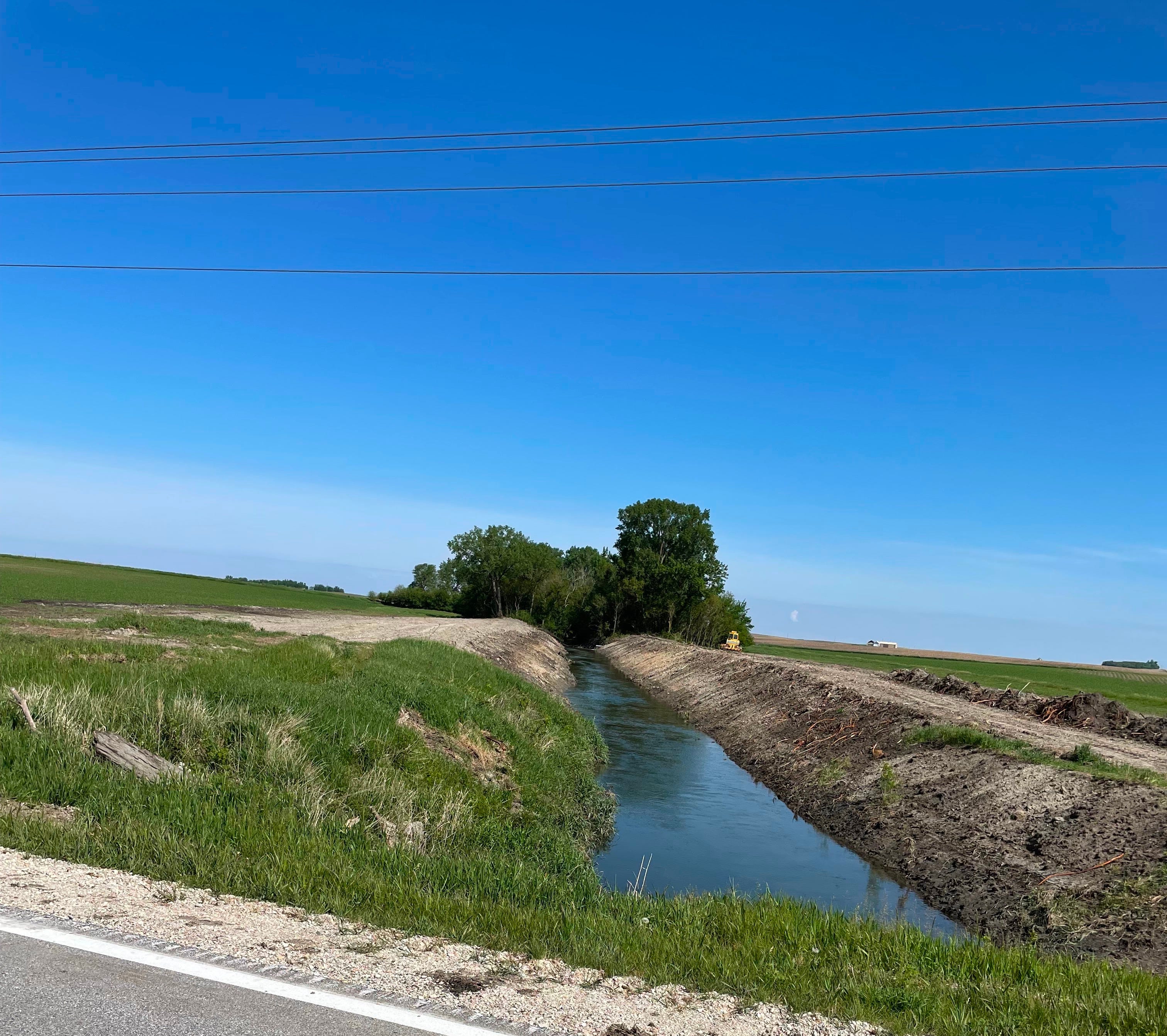
In order to increase the square feet of crop land it is common practice to straighten the winding creeks that once veined through the landscape, with small groves of trees on either side. A few weeks back, we drove past a flock of backhoes, cranes and bulldozers sitting at the edge of a creek not far from our house. “Oh fuck oh fuck oh fuck!” S moaned. “They’re getting ready to destroy that little creek”.
“Maybe not.” I murmured, hoping she was overreacting.
Many of these fields had been planted by family farmers decades ago who also grew gardens to feed their families. They left the stalks and residue after harvest, for livestock to graze on, fertilizing the soil as they wandered through, and keeping the topsoil happy and intact. Every now and again if S or I notice cattle grazing in a field of corn stalk or soybean stubble, we will clap and cheer for the farmer who is doing things right.
Before those farmers tilled and flattened the fields, this had all been a tall grass prairie teeming with over 300 species of plants. I learned from a very informative rest area display that their roots can reach up to 12 feet underground entangling and keeping the soil in place under the high speed winds common to the Midwest. The prairie ecosystem sustained and gave shelter to numerous mammals, reptiles, amphibians, birds and insects including pollinators such as bees, monarchs, pearl crescent butterflies and hummingbirds.
For millennia the Ioway, Meskwaki, the Sauk and Kiikaapoi coexisted, sustaining and being sustained by the flora and fauna in Iowa. They set fires to burn away competing shrubs and invasive species, they harvested grasses, forbs and seeds, being mindful of leaving plants behind to reseed and maintain their survival. They hunted small and big game as integral parts of a balanced ecosystem.
As white settlers colonized the area, they displaced and erased (as best they could) the native people from the fertile land.


Increasing numbers of herbicides and pesticides have been developed and sprayed over the land, erasing the whole tallgrass prairie ecosystem. Erasing the institutional knowledge that the first human residents of the region carried - in the name of progress and efficiency.
As I turn from gravel to paved road I reflect on how in the last six months the Cheeto has signed executive orders to erase all evidence of the diversity in our country - much like the way the diversity of terrain I drive through is being erased. I drive past what had once been the meandering creek, to see a straight ditch with all of the trees removed. The cluster of machinery visible a quarter mile down. Shit - S wasn’t overreacting - a sinking ache in my gut. There goes more habitat, more diversity, more life in order to get a few more bushels of corn.
Out here in the heartland corporations are erasing the legacy and culture of family farms. In the 1980s and 1990s farmers were opting for monocrops and getting rid of their gardens in exchange for bigger, higher yielding corn and soybean fields. The farming industry was devastated by a complex web of rising interest rates, high debt, lower demand and lower prices for their products. During the 80s farming crisis as small town banks were being bought up by conglomerates, farmer’s debt rose much higher than their yields. Farming families suffered from food insecurity. It is now rare to see a family farm with both crops and livestock coexisting and supporting each other. These days most farmers don’t own the land they farm. They rent acres (of what they may have once owned,) working the land now owned by corporations.4
I move the radio dial to a classical music station, reflecting on the fact that we live in the aftermath of erased traditions which included respect, and nurturance of biodiversity as well as appreciation and acceptance of diversity in communities, respect and care for elders, acceptance of two spirit people, recognition of the special abilities of those who do not fit into norms of ability and gender expression.
I’m back on the gravel again and come across a little patch of prairie grasses, growing tall and beginning to green out with spring growth. Someone has set aside a few acres to nurture native plants and pollinators! I wonder who it is and whether they practice controlled burns on this patch of land.
I wonder what it will take to set fire to the invasives that have been released in our government. How we can vanquish intolerance, cruelty and hate, allowing the diversity and beauty in our imperfect country to flourish once again.
Post script: It has taken me weeks to finish this piece and in that time millions of us came out on the streets for “No Kings Day” - it gives me a similar burst of hope as coming upon tallgrass prairie land, a winding creek, or cattle grazing on harvested fields does. It’s a good start, but we need much much more!


This is by no means a scholarly work - please feel free to comment on or correct anything I’ve gotten wrong.
Bureau of Alcohol, Tobacco and Firearms
There is no administrating going on, it’s a slash and burn of all the checks and balances based on the huge ego of a deeply insecure, small man.
I asked S for some background for this paragraph and she directed me to the 1984 Sam Shepherd, Jessica Lang movie “Country”. It does a beautiful, heartbreaking job of painting a picture of life in 1980s in Midwest farming communities.
Paradise lost and many of us are screaming too.
Thank you for this heartfelt, passionate message. Over the years I’ve often felt that our lack of diversity made Iowa a boring state. There are pockets of hope but they need to expand.
On a side note that I think is hopeful is that nearly 50% of Iowa is owned by women. An organization WFAN.org, has been working with women landowners to educate and empower decision making on the land they are caretakers of. Women who own land have the opportunity to change the Iowa landscape. We can do it.
Also, a high percentage of Iowa farmland is still owned by families who have formed a business corporation and Iowa has a law that restricts corporate ownership somewhat.
You are absolutely right about the movie “Country” it is a fairly accurate portrayal of the farm crisis. Glad S turned you on to it.